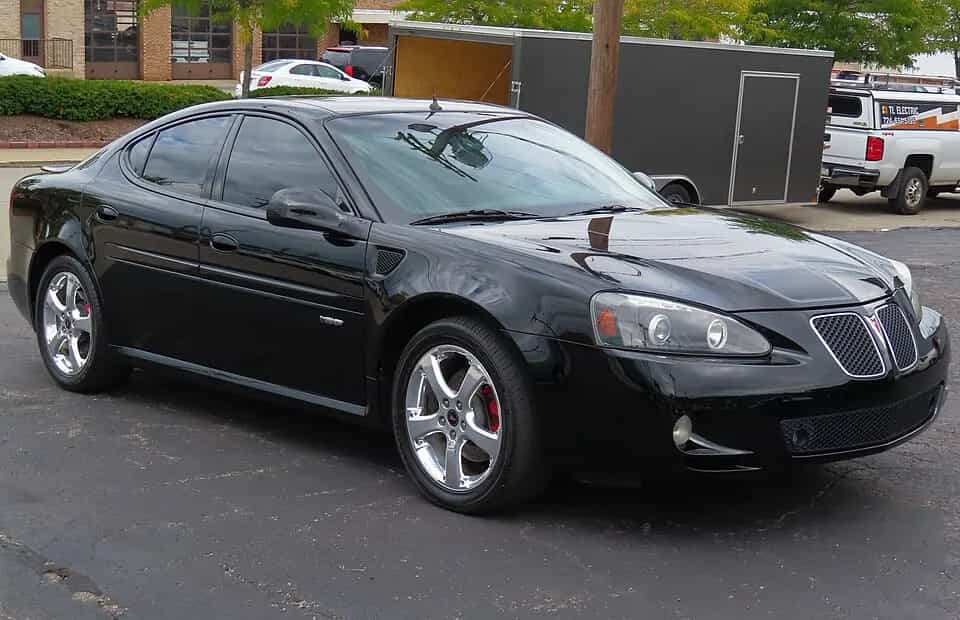
Pontiac Grand Prix

USCar Trader import service

Import this model from the USA or Canada

Choose a specific vehicle. Where data is available, its detail page shows the import cost calculation. We assess any possible duty benefit with you before purchase.

Important: A 0% EU import-duty rate may be available for a vehicle covered by Regulation (EU) 2026/1455 that has US origin and is imported directly into the EU. CETA may apply to a vehicle with preferential Canadian origin. Whether the requirements are met is assessed for the individual case. Please contact us before purchase; we review the possible duty benefit and provide non-binding support through the process. Import VAT and other costs are assessed separately.

CarHub · Pontiac

Pontiac Grand Prix

The Pontiac Grand Prix is a genuine slice of American everyday performance history: a front-drive sedan that, in its hotter versions, packed a supercharged 3800 V6 and, right at the end, a small-block V8.

Production years (relevant)
Detail (6th–7th gen Grand Prix): 1997–2008
Body styles
Detail (6th–7th gen Grand Prix): 2-door coupé (to 2003), 4-door sedan
Platform
Detail (6th–7th gen Grand Prix): GM W-body
Base engine
Detail (6th–7th gen Grand Prix): 3.8L V6 (L36 / Series III)
Pontiac Grand Prix

Model profile

Model history and generations

Importing a used Pontiac Grand Prix from the USA

The assessment depends on the specific vehicle and the circumstances of the transaction. Please contact USCar Trader before purchase; we review any possible duty benefit and provide non-binding support. Import VAT and other costs are considered separately.

Generations at a glance

The Grand Prix name spans decades, but the imports that matter most are the front-drive W-body cars.

Powertrain and equipment

Engines, drivetrain and trims

Powertrain lineup

The heart of the Grand Prix story is GM's 3800 V6. The naturally aspirated 3.8-liter (L36, and later Series III) produced around 200 horsepower, while the supercharged 3800 (L67, later L32) in the GTP made roughly 240–260 horsepower with strong low-end torque courtesy of its Eaton blower.

Trims in the US market

Sixth-generation cars came as a two-door coupé and four-door sedan in SE, GT and GTP forms. The seventh generation was sedan-only, offered as base, GT (supercharged) and GXP (V8), with a Comp G package late in the run.

Vehicle selection

North American market and suitability

The used market stateside

Grand Prix supply in the States remains reasonable, with plenty of sixth- and seventh-generation cars still in circulation.

Who should import one

The Grand Prix suits a buyer who wants an affordable, torquey American sedan with real personality and a strong parts network, especially fans of the supercharged 3800 or the rare front-drive V8 GXP.

Vehicle data

Technical data by generation and specification

Body and dimensions

Body stylesDetail (6th–7th gen Grand Prix): 2-door coupé (to 2003), 4-door sedan
PlatformDetail (6th–7th gen Grand Prix): GM W-body
SeatingDetail (6th–7th gen Grand Prix): 5
LengthDetail (6th–7th gen Grand Prix): approx. 5,000 mm (7th gen)

Engine and drivetrain

Base engineDetail (6th–7th gen Grand Prix): 3.8L V6 (L36 / Series III)
Base powerDetail (6th–7th gen Grand Prix): approx. 200 hp
GTP engineDetail (6th–7th gen Grand Prix): Supercharged 3.8L V6 (L67/L32)
GTP powerDetail (6th–7th gen Grand Prix): approx. 240–260 hp
GXP engineDetail (6th–7th gen Grand Prix): 5.3L LS4 V8
GXP powerDetail (6th–7th gen Grand Prix): 303 hp
TransmissionDetail (6th–7th gen Grand Prix): 4-speed automatic (4T65-E / HD)
DrivetrainDetail (6th–7th gen Grand Prix): Front-wheel drive
FuelDetail (6th–7th gen Grand Prix): Regular/premium (GXP premium)
Fuel tankDetail (6th–7th gen Grand Prix): approx. 64 L

Model and other data

Production years (relevant)Detail (6th–7th gen Grand Prix): 1997–2008

Values are reproduced verbatim from the existing article table. The documents for the specific vehicle govern.

Pre-purchase review

Model-specific inspection points

Inspection plan for this model

For the Pontiac Grand Prix, the agreed inspection plan focuses in particular on vehicle history, visible body and underbody condition, fluid leaks, warning messages, tyres, brakes and accessible suspension components. USCar Trader can document these points through a separately commissioned on-site inspection; inaccessible areas or unauthorised road tests are explicitly recorded as unchecked.

Germany and Europe

Differences, adaptation and registration

What US models do differently

American Grand Prix cars use US lighting, MPH speedometers and US emissions calibration.

German TÜV and registration

US-market headlights use the FMVSS/SAE beam pattern, which differs from the ECE pattern required in the EU, so they may need adjustment or replacement with ECE-compliant units for registration.

USCar Trader services

Inspection, purchase processing and escrow

As a buyer based in Germany, you do not have to inspect the vehicle yourself in the United States or Canada. Within the agreed scope, USCar Trader can coordinate document review, a separately commissioned on-site inspection and purchase processing.

  • Vehicle profile and history: The profile can show the VIN, US title status and available history records. No data source guarantees that every earlier event was reported.
  • Optional CARFAX report: Additional reported maintenance or service entries can be included. The report is not a complete service book or proof of every interval.
  • On-site inspection / USCT AutoCheck: USCar Trader can arrange a separately booked vehicle inspection. Agreed visible and accessible areas are documented. Road or functional tests require suitable access and seller approval; the visual review is not a lift inspection or workshop diagnosis.
  • Purchase processing and escrow: After approval, USCar Trader can coordinate seller contact, negotiation, contract and the escrow and import service. Fees, payment route and responsibilities are recorded in advance.
  • Recalls: Open safety recalls can be checked by VIN through the NHTSA recall search; they do not describe overall condition.

Covered inspection points are agreed in advance. An on-site inspection records condition at the appointment and is not a guarantee.

Next step: Before commissioning, USCar Trader and the customer agree which document, history, inspection and transaction checks suit the vehicle and are included in the service. This records what was actually checked.

Import process

Import, customs, costs and delivery

Seven steps to your import

The assessment depends on the specific vehicle and the circumstances of the transaction. Please contact USCar Trader before purchase; we review any possible duty benefit and provide non-binding support. Import VAT and other costs are considered separately.

Questions and answers

Common questions about importing this model

Is the supercharged 3800 reliable?

Yes, it is a robust engine, but watch the plastic intake manifold and supercharger coupler; both are known service items that are cheap to address.

What is special about the GXP?

It is the only Grand Prix with a V8 — a 303-horsepower 5.3-liter LS4 driving the front wheels — making it the rarest and most sought-after version.

Does this vehicle automatically qualify for a 0% import-duty rate?

No, not automatically. A 0% EU import-duty rate may be available for a vehicle covered by Regulation (EU) 2026/1455 that has US origin and is imported directly into the EU. CETA may apply to a vehicle with preferential Canadian origin. Whether the requirements are met is assessed for the individual case. Please contact USCar Trader before purchase; we review the possible duty benefit and provide non-binding support. Import VAT and other costs are assessed separately.

How is import VAT treated when importing a Pontiac Grand Prix?

Import VAT and other taxes or costs are assessed separately under the applicable rules and the circumstances of the individual case. A blanket answer for every vehicle would not be reliable.

Are parts hard to find in Germany?

Mechanical parts for the 3800 and LS4 are widely available and affordable; some trim pieces are easiest to source from the US.

Coupé or sedan?

The coupé was offered only through the sixth generation (to 2003); the final 2004–2008 cars are sedan-only.

What is the biggest thing to check on inspection?

The cooling system and intake manifold on the 3800, and rust on cars from northern states.

Can USCar Trader handle everything?

Yes, as an independent broker we manage selection, escrow, shipping, customs and TÜV, without acting as the selling dealer.

More vehicles